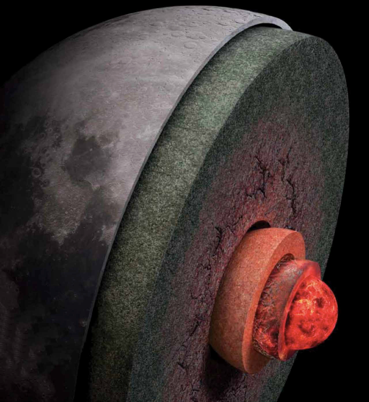
The Moon has been the cornerstone of our understanding of terrestrial planet formation and early evolution since the Apollo investigations 40 years ago. Geochemical studies of returned samples combined with geophysical experiments such as laser ranging, magnetic induction, heat flow, gravity, and seismology have all contributed to the currently accepted large impact formation and subsequent magma ocean differentiation model of the Moon’s earliest history. This paradigm has successfully illuminated our understanding of early planetary evolution for decades.
Of all the bodies in the solar system, the Moon is uniquely accessible for both orbit- and ground-based geophysical studies, and the recent increase in both domestic and international lunar missions emphasizes this fact. The geophysical experiments deployed on the lunar surface during Apollo remain the benchmark for ground-based studies on other planets. As such, ongoing analysis of this unique data set continues to yield new information relevant to the Moon’s formation and evolution, and encourages the development of data analysis techniques that can be applied to future planetary geophysical data.
Our work focuses on the Apollo seismic data. The Apollo Passive Seismic Experiment consisted of a network of four seismometers deployed on the lunar surface between 1969 and 1972. Data from these instruments were recorded continuously until late 1977. Several types of seismic signals were recorded, including natural impacts (meteoroids), artificial impacts (booster rockets from the Apollo spacecraft, and the landers themselves), shallow moonquakes (natural events occurring in the upper 50 to 220 km of the Moon), and deep moonquakes (natural events occurring between 700 and 1000 km depth).
and the volatile content of the mantle remain controversial. Advancing our understanding of the Moon’s interior is critical for addressing these details. The Moon’s lack of Earth-like plate tectonics means that a record of early planetary differentiation has been preserved. With that in mind, future ground-based missions can build on the legacy of Apollo by designing instruments capable of addressing deficiencies in the existing lunar data.